Don't be misled by coincidences.
Imagine walking into a room full of monkeys — a huge (infinite) number of them. Each one has a keyboard in front of it. Each presses whatever key its finger lands on. Most of them type nonsense. No meaning at all, completely unreadable. But among them, one or two get something right. For example, without knowing it, one might type the words “mom” or “me.” According to probability theory, one of these infinite monkeys will, by pure chance, retype the Iliad. Or another will reproduce an exact copy of War and Peace. Since the starting number of monkeys (the sample) is infinite, it’s no surprise that such works come out. On the contrary, we’d be surprised if they didn’t. But writing this beautiful novel isn’t the monkey’s achievement, is it? Our friend from the animal kingdom is just one of the lucky few among a vast crowd of monkeys. Take the monkey that (by chance) managed to write War and Peace — do you believe it could follow up with Crime and Punishment? The chance of getting that lucky a second time is tiny. Close to zero. This isn’t the monkey’s achievement — it just got lucky.
The guests on the podcasts we watch, the authors of the books we read — didn’t they reach that level simply because they got lucky? Isn’t the advice they give the kind that worked once and is unlikely to work the next time?
Now let’s push the example a bit further. The monkeys that typed nonsense are taken out of the room. Only the ones that wrote beautiful works and deep books remain. What would we think walking in for the first time? “Wow, monkeys are geniuses!” we might say. Only when we learn how many monkeys there were at the start do we realize we’ve been fooled.
Another example. Let’s look at the world of traders (people who trade on the stock exchange). Say a trader has a 50% chance of ending a year in profit. Either profit or loss. If we start with 10,000 traders (our sample), by the end of the year 5,000 remain (50%). By the end of year two, 2,500 make it. In year three, 1,250. By year six, 156 traders are left (the lucky ones).
Now these 156 traders, having been profitable for six years, think they’re brilliant. They give interviews. They write books. They teach how to build the right strategy. But most of them won’t admit they simply got lucky. Victor Niederhoffer is an example. From 1980 on, he made solid profits. He wrote books. He became one of the most famous traders in the world. In 1997, his company lost all its money. He declared himself bankrupt.
Monte Carlo Simulation
The Monte Carlo method is, at its core, a mathematical method, and it helps solve certain kinds of problems. Mathematicians aren’t very fond of it, because it doesn’t solve problems through formulas or axioms. It’s a method of getting the answer by doing the same thing over and over. For example, if we ask what the probability is of a coin landing heads, the Monte Carlo method tosses it a huge number of times. And from that, it concludes it’s 50%.
We don’t need the mathematical side. Taking the essence is enough. Before doing something, we run it again and again in a thought experiment.
Take a dentist as an example. He studied very hard and was one of the best students at university. Even after starting work, he kept reading serious books. He spent a lot of money on professional development. And he lived like that for years. By around 25, he was the best dentist in his country. Then, by his mid-30s, he became the best dentist in the world. A single operation of his came to cost $50,000–$100,000. He started saving and investing, and by 40 he had accumulated $10 million.
This dentist had a classmate. Since childhood, he’d wanted to start a business. That’s why he didn’t go to university. He’d cite Zuckerberg and Steve Jobs as examples. Forget university — he didn’t develop himself either. Wherever he got a job, he treated it as temporary. And he left every one of them soon after. That’s how he, too, turned 40. One day he played the lottery and, by chance, won $10 million.
Two classmates. Both have $10 million. In terms of money, they’re equal. But can we really say these 10 million are equal? Let’s apply the Monte Carlo method.
If the dentist lived his life 10,000 times, following the same path each time, in roughly 1,000 of them he’d reach this level again. In another 8,000 cases, he’d earn an above-average salary. In about 500, he’d make an average living. And in the remaining 500, he’d end up with a poor result. All numbers are approximate.
As for his lottery-winning acquaintance, if he lived 10,000 times, the chance of winning the lottery again is extremely close to zero. With principles like his, the chance of his business taking off is also low. Maybe in 100–200 cases it works out.
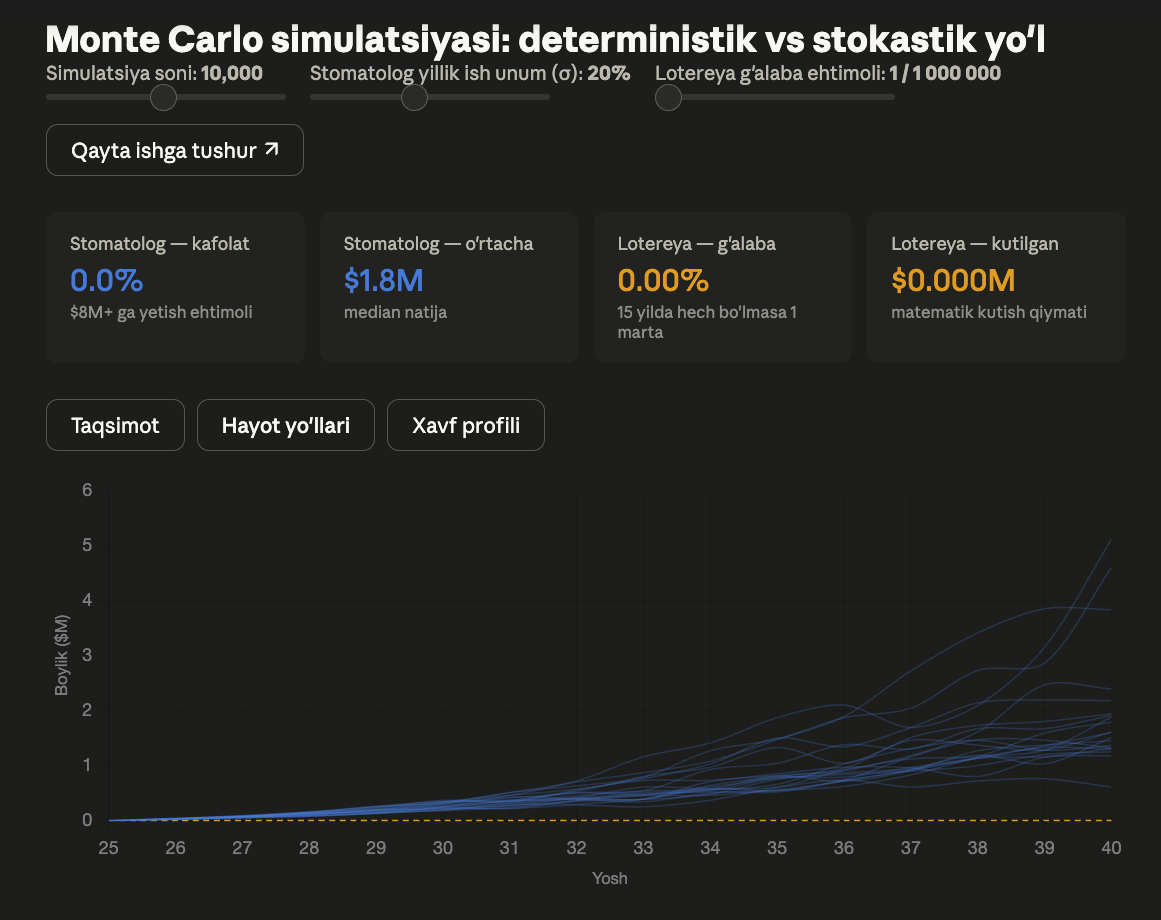
In blue are the paths the dentist could have taken. In yellow is our brother who believed in the lottery.
The Monte Carlo method says the dentist doesn’t carry much risk. He wins often and loses rarely. Our lottery-believing friend wins big once. But in between, he loses a lot.
What does this give us? It gives us resilience to shocks. It helps make sure a single event doesn’t cost us everything. Like the blue paths above, we can see each of our ventures.
If you want to start a business, think through these paths. If it takes off, it’ll be a huge success. One of the luckiest paths. But that’s just one outcome out of thousands. Another outcome might be a business with average income. Interesting. And the worst outcome? If your family would go hungry, or you’d lose your home and end up on the street — starting the business is very dangerous. But if, even if the business fails, you’ll still have a job and money, then this event won’t break you. You can withstand the blow.
Or say you want to buy an apartment. You’re thinking of buying in an unfinished building for less and selling for more once it’s done. Let’s run thought experiments. How much would I make in the luckiest case? How much on average? How much would I lose in the worst case? If the money you could lose won’t turn your life upside down, it’s probably worth the risk.
Ray Dalio has a similar principle:

Conclusion
A lot of unexpected events happen in our world. Taleb calls them Black Swans. And it’s precisely these Black Swans that end the careers of so many businesspeople, politicians, investors and others. Sometimes such events make someone rich. And then they start writing books and giving interviews. This doesn’t mean “they achieved nothing, don’t listen to them.” It’s just a small reminder not to forget critical thinking. Heard some advice on growing your business? Think it over. Is this person worth taking such advice from? What could I gain if I apply it? And what could I lose?
I used to consider myself someone who had achieved good results, who had gotten well ahead of my classmates and friends. While reading a book on this topic, I started to wonder. Maybe none of this was the result of my own actions? Maybe I got here because circumstances happened to line up? So I went back over my life. Most of my achievements turned out to be the result of luck. My parents, my teachers, circumstances, friends… I haven’t yet done anything to be proud of.
And now some food for thought: is what you’ve achieved really your own achievement?