Who Is Responsible?
Recently we went to see a client. We were supposed to sell them software. An intern came with me. We sat down and talked. In the end, the client turned our offer down. We left. On the way back, the intern started bad-mouthing the client. He said the guy knew nothing, was trying to act smarter than he was, and needed to learn how to listen to people.
That caught my attention, because the first thing I thought about when we walked out was where I had gone wrong. I told the intern about our mistakes. For example, the client was in a hurry, and we never asked how much time he had. We talked out on the street, and it was noisy. We talked about something that didn’t interest him, so he didn’t listen. And I listed about ten more of our mistakes.
I think this way because I have a principle about it. In the previous essay we talked about principles.
I study podcasts, books, biographies. I try to find the author’s principles. The story above is also the result of a principle. The principle of always taking responsibility for the outcome. I tried to remember who I first got this rule from, and couldn’t. Because almost everyone I’ve observed has this principle. It’s probably one of the oldest on my list.
We are the cause of everything that happens in our lives.
If you look around, it’s a sad picture. I don’t know the exact statistics, but roughly seven out of ten people I meet are always trying to find someone to blame. Trying to shift responsibility onto someone else.
Look at this picture:
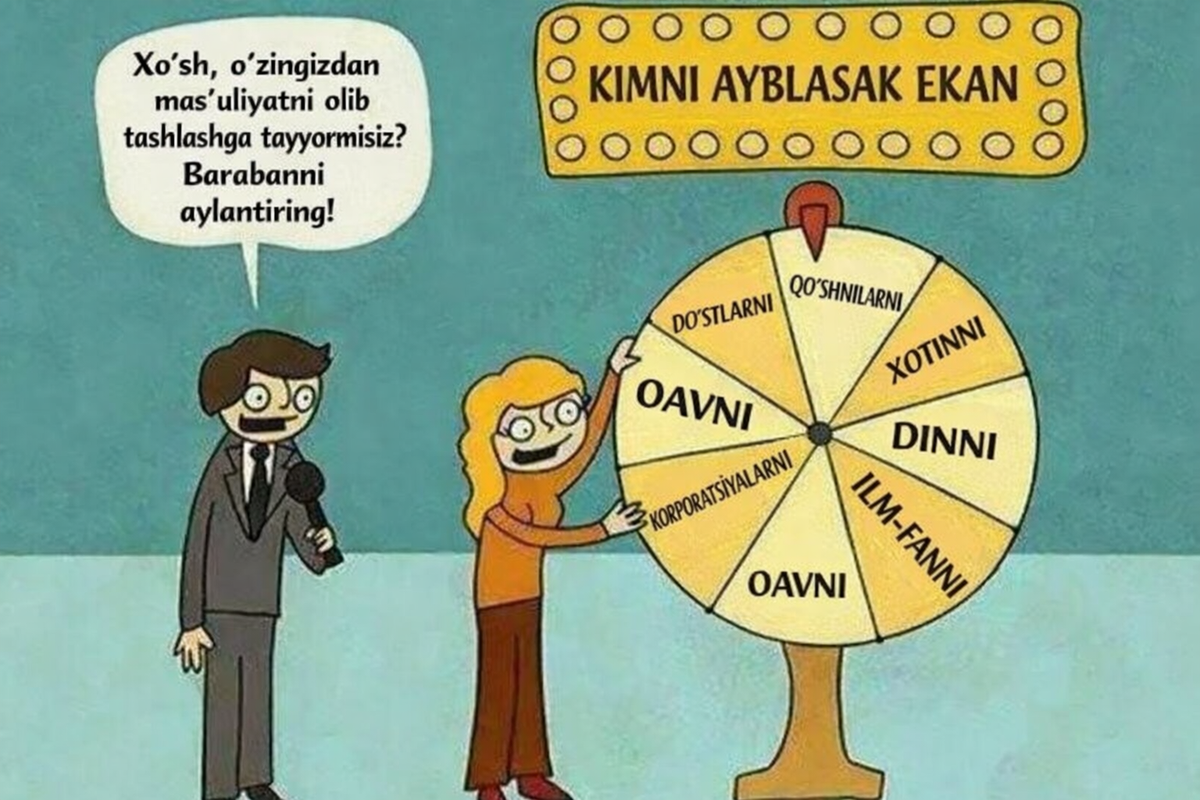
It’s as if everyone around is playing this game.
- “The bus was slow, so I was late” (the driver)
- “The traffic cop was hiding behind a tree, I didn’t see him. He gave me a fine” (the police)
- “I started a business. It didn’t work. The government is strangling us. They wrecked the economy” (the government)
Everyone is busy blaming someone.
As I was writing these lines, culinary inspiration struck. I wanted to cook something. I went to the kitchen. No potatoes left. My first thought: “Why didn’t anyone at home tell me? I went to the market just yesterday…” Notice that? We spun the wheel. Did the blame land on the family? I stopped myself. Couldn’t I have checked before going to the market? Even while I was at the market, I could have called and asked what we were out of. I didn’t. The responsibility is mine.
Where we are now. The home we live in. The car we drive. The face in the mirror. We are the cause of all of it. We are responsible for all of it.
Some people object. We can’t be responsible for everything. You can’t control things 100%. I have one answer to that:
Personal responsibility isn’t about controlling everything. Personal responsibility is about being able to influence any situation we’re in.
Let’s take an example. Imagine you’re at university. You came to class. Today you have a very important exam. The class monitor promised to bring all the answers. So nobody is worried. The monitor arrives. But he’s lost the answers. What do we do? What comes to mind?
We have two paths in front of us.
1 — We can sit and moan along with everyone else. Blame the monitor, join the shouting. Everyone’s doing it, after all. It’s the monitor’s fault, isn’t it?
2 — Or we take the blame ourselves. We shouldn’t have relied on someone else. Let’s ask ourselves: “What can I do?” Let’s think. Maybe students from another group have the answers? Probably the senior years have them too. Who gets along well with them? Maybe if that friend asks, they’ll help?
Get it? There’s a formula:
responsibility = influence
When we shift responsibility onto someone else, we also lose the power to influence the situation.
Putting personal responsibility to work
What if, in any situation, the person responsible had a crown on their head?
In fact, that crown exists. The crown of blame. We just can’t see it.
If you’re late and blaming the bus, the driver is wearing the crown.
Our job is to always take the crown for ourselves. No matter what happens, we take the crown.
The moment we take the crown and put it on, our thinking changes. We take responsibility. One question can help here. The question “What can I do?” Ask it, and your brain immediately starts looking for a solution. Maybe that’s exactly what separates heroes from the crowd.
To sum up, in any situation:
- We take the crown for ourselves.
- We look for an answer to “What can I do?”
Once this principle sinks in, people split into two types: those who take responsibility and those who look for someone to blame. You want to be around the first. You’ll naturally drift away from the second.
When we blame others, we hand the steering wheel of our life to someone else. Other people are driving our life. Parents, the government, the boss, the family. When we take the wheel into our own hands, life gets harder. But now we’re the ones driving it.