Leverage
I once read something by Aziz Rahimov. He recommended that if you want to get better at something, you should measure it. For example:
If you want to save money, measuring your expenses helps.
If you want to fix your sleep, measuring how many hours you sleep each day helps.
If you want to lose weight, counting calories helps.
And so on…
And “measuring,” it turns out, is close to studying. For example, Newton discovered the theory of gravity in 1687.
But people knew about it before Newton too. They saw that when you throw something, it falls to the ground. Yet that “knowing” didn’t give them much.
The big inventions came after gravity was given a name, put into a formula, the Earth’s pull was calculated, and people began to study it as a science. Tall buildings, bridges, hydroelectric plants, satellites, planes, rockets. All of these were built after we were able to study gravity.
I’ve noticed the same thing in life. There are many people around who know certain things on an intuitive level. They know, but they haven’t studied it. If they did, they’d probably get better at it.
Today I want to gather my notes on one such thing that many people know but haven’t studied. Leverage.
Lately, the idea of leverage has become “fashionable.” For example:
In the essay “How to Make Wealth,” which made Paul Graham famous, he says:
To get rich you need to get yourself in a situation with two things, measurement and leverage.
Andrew Grove (the founder of Intel) wrote in his book High Output Management:
A manager’s time is limited. His job is to spend that time on high-leverage activities.
Naval Ravikant, in his essay “How to Get Rich (without getting lucky),” says:
Figure out what you’re good at and use the biggest leverage you can.
All right, it’s probably easier to remember through a definition and an example.
Leverage is any tool that brings a bigger result than the resources you put in.
Resources can take the form of money, time, energy, knowledge, or strength.
Here’s an example:
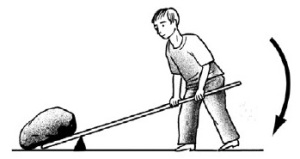
Apply 100 kg of force on the right, and you can lift a 500 kg stone on the left. The simplest form of leverage.
Without a lever, lifting a 500 kg stone takes 500 kg of force (1:1). With a lever, we use less force (1:5) but get a big result.
When I was just starting out in sales, we used to collect business owners’ phone numbers from OLX. It took 1–2 hours to collect them. Then one day I sat down for 3 hours and built a bot. Hooked up to AI. I’d tell it the industry and how many numbers I needed, and it would collect them in 5 minutes. Now I was doing 2 hours of work in 5 minutes.
And another sales example. A problem you see in most new salespeople. They spend a lot of time on the wrong client. If a client says they need the product, they’re eager to go over and give a presentation. The trip and the presentation take 3–4 hours. In the end, they find out the product isn’t a fit for the client. If they had filtered at the start, they could have spent those 4 hours more effectively. In this case, the filter is the lever. Sit down once to build a filter, and your effectiveness goes way up from then on. To start, you can even use the BANT filter created at IBM. Over time you adapt it to yourself. Five minutes of filtering can save four hours.
Or let’s talk about the most valuable skill of the 21st century. The ability to absorb information. At school, at university, or just for yourself, you want to learn something new. You can spend hours memorizing. Or you can try the Feynman method. This essay, in fact, was written using Feynman’s rule. Instead of spending several days memorizing, I learned it better in two hours by writing an essay.
Another example. We are all “managers.” Some manage employees, some manage their families, some their younger brothers and sisters. A manager has to grow their people. Mentors say this a lot. Knowledge is a trust, after all. And looking at it mathematically, it turns out to be a very sound decision and a big lever.
If a leader gathers the team and gives them knowledge that raises their level, they may work a little better. Even if they work just 1% better, a team that sells 1 billion could bring in 10 million more. On one side of our lever is a two-hour training (plus follow-up); on the other side is 10 million soum.
And even so, some people think, “I won’t share what I know. If I do, my employees will grow and leave me.”
I’ve covered leverage at work in part. But personal life is packed with levers too.
One of the biggest is probably sleep. Fixing your sleep doesn’t take much effort. But once it’s fixed, your hormones start to balance out. Thanks to that, your mood improves. Brain function, it turns out, improves by 19–40%. EQ (the emotional version of IQ) can improve by up to 60%.
For a man, the gym is also a very strong lever. Health, energy, sleep — we already know about those. But it turns out there are other benefits too. Men who look physically bigger are seen as more attractive by women. Instincts haven’t gone anywhere. And such people are seen as higher status. I saw another study, but couldn’t find it again. Roughly: on average, top managers looked bigger (stronger) than middle managers and regular employees. And people with more body fat than they should have are seen as unattractive.
The goal of leverage is to avoid spending energy on unnecessary routine and to stay busy with the things that bring the biggest results. To picture it, think of each task as a stone and try throwing the stones into water. The size of the ripples is how important the task is and how much impact it has. Collecting numbers from OLX is a grain of sand. It isn’t worth spending time on. Talking to a potential client is a fairly heavy stone. If they aren’t a real prospect, it’s a very small stone. We use a filter to sort the small stones from the heavy ones. And the goal at work is to make the biggest ripples.
Besides the good sides, leverage has its downsides too. For example:
It takes preparation. Building leverage takes time. I spent 3 hours building the bot. To set up a “filter” in sales, you need to spend time thinking it through. To build up your body, you need to train for at least a year.
The stronger your preparation, the bigger the lever you can build. Maybe that’s why mentors say not to start a business before 30, but to build your network, knowledge, and experience instead? Maybe they wanted us to prepare? Maybe you can make a big lever out of life itself? Heh, interesting. Very interesting.
Quality also suffers. In management, leverage lowers quality. You can hand a task to someone else. They won’t do it as well as the leader. In sales, when you filter clients, some real prospects may slip away too. The bot might pull in numbers you don’t need.
Leverage is an amplifier, not a creator. Leverage amplifies what is working well. It breaks what is working badly even further. But it doesn’t create anything from zero.
How do you find levers?
You need to look around. The only way I know is questions and checking. Everyone probably has their own questions. I don’t think I even know mine very well. Here I’ll try to recall roughly what I think about and write it down:
- Is there a way to do something I do day after day just once, so it never bothers me again?
- Can someone else do the work I’m supposed to do?
- Is there someone who has already done what I need to do? Can I ask for advice from their experience?
- What can I do right now that will make the biggest impact (ripples in the water)?
I think I’ve found all my levers by answering these questions.
That’s the end of my notes. That’s what I wanted to think through today. Today I wrote about what leverage is. Maybe in another essay I’ll write about the types of leverage, why it matters, its strengths and weaknesses, its fragility and antifragility.