Be Like the Hydra
Yesterday my colleagues and I discussed Taleb’s book Antifragile. I thought it was a really interesting conversation. It’s no accident that group discussions are considered one of the most effective ways to exchange knowledge.
Because in a group conversation, questions can come up that you never would have imagined. In that moment, you realize what you don’t know.
Munger said it too:

“Knowing what you don’t know is more useful than being brilliant.”
All right, back to the book. I decided to write down the most important insights (takeaways) from that conversation so I don’t forget them. You could probably call it a short summary of the book.
Black swans
The swan is a bird that is usually white. Even if every swan you’ve ever seen in your life was white, Taleb says we can’t claim that every swan in the world is white. And indeed, very rarely, black swans do turn up in nature. For scientists, a black swan is an unexpected event.
In the economy, black swans (unexpected events) happen all the time too. For example:
- 1980, the oil crisis in the USSR
- 2000, the dot-com bubble
- 2008, the Great Recession
- 2010, the European debt crisis
- 2020, Covid-19
I remembered that many without even trying. Think how many I don’t know about. And every time a black swan like this arrives, some break and disappear. Others grow stronger.
Some people aren’t ready for black swans. Others turn out to be ready. Let’s talk about these states.
The three states of any object
According to Taleb, any person, team, company, country, or other system can be in one of three states: fragile, robust, and antifragile.
Let’s start with an example:
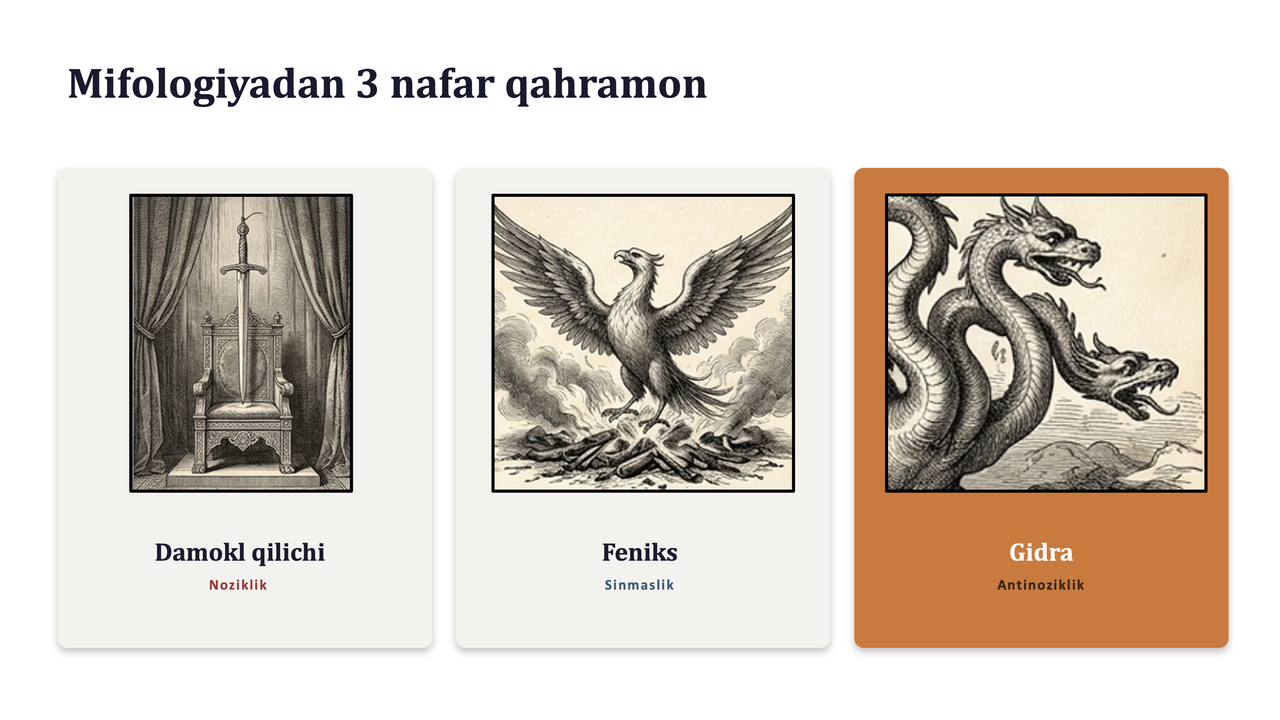
- The Sword of Damocles.
According to legend, Dionysius, the ruler of Syracuse, had a flattering courtier named Damocles. Damocles kept saying how luxurious and happy the lives of kings were, and envied them. In response, the ruler invited him to a feast and seated him in the place of highest honor. But when Damocles looked up, he saw a sharp sword hanging over his head by a single horsehair. With this, Dionysius showed that power and wealth mean living under constant threat, and that disaster could strike at any moment.
Any unexpected event (someone sneezing, slamming a door, or bursting out laughing) would have meant Damocles’ death. That’s why he is in a very fragile state.
- The Phoenix.
The most famous legendary bird of ancient mythology, a symbol of rebirth from its own ashes, immortality, and renewal.
It can’t be killed. Whatever happens, it always lives. So it’s in a robust state.
- The Hydra.
One of the most terrifying and invincible monsters, known for its body, its supernatural traits, and its destructive power. The reason the Hydra couldn’t be defeated in battle was its endless ability to regenerate. If one of its heads was cut off with a sword, two (sometimes three) new heads immediately grew from the stump.
The Hydra, on the other hand, loves unexpected events. Every black swan makes it stronger. Cut off a head, and it becomes even stronger than before. This state is the opposite of fragility. That is, it’s antifragility.
Some might say, “What do I need this for? I have a job, I get a salary…” Let’s take a turkey as an example.
Imagine. A farmer fed a turkey for 1,000 days. He gave it feed and water. He raised it big. In the turkey’s mind, the farmer loves it. After all, he’s taken care of it for 1,000 days. The turkey did nothing and lived calmly. But on day 1,001, the farmer makes turkey soup.
This isn’t about the turkey.
Getting closer to antifragility (becoming like the Hydra)
The barbell strategy
A fragile person risks all their resources. A robust person keeps everything somewhere very safe. An antifragile person doesn’t get stuck at one extreme. They keep things safe and take risks too.
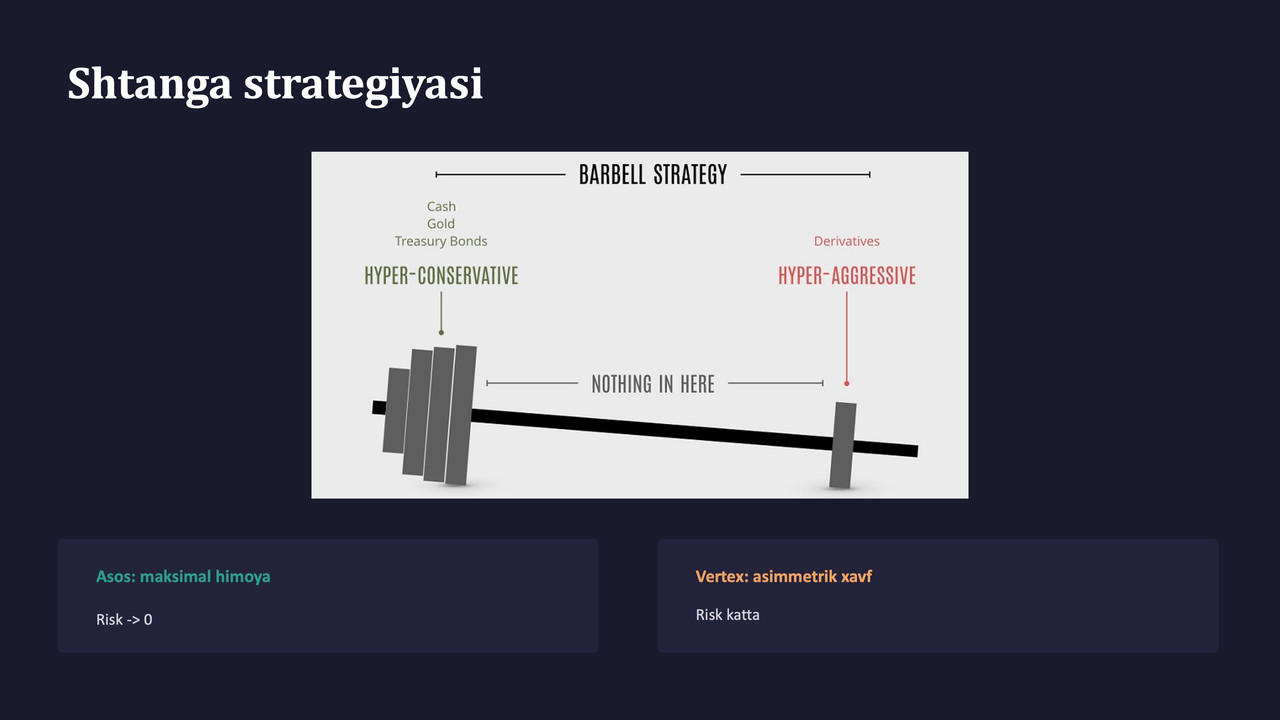
If you keep 85–90% of your resources somewhere very safe and conservative, most of your assets will be secure (a stable job, cash at home, gold, and so on).
Put 10–15% of your resources into something very risky with big potential (a startup, risky stocks, new projects).
The result: even if that 10–15% burns up, you won’t break, because most of your assets are safe. But if the risk pays off and you win, your life changes.
Inner reserves
From an efficiency point of view, reserves are bad. But from the point of view of antifragility, they’re your safety.
- Always keep a cash reserve at home.
- Build a reserve of skills: learn several trades.
- Build a reserve of income sources. Let money come from several places.
Look for small mistakes
From any mistake you can learn something about the system. You can learn from big mistakes and from small ones. Make mistakes. If your mistakes are early, small, and many, you can gather a lot of information.
It’s far better to learn that you can’t trust everyone as a kid, when someone tricks you out of your toy in the sandbox, than in a big business, when your partner betrays you.
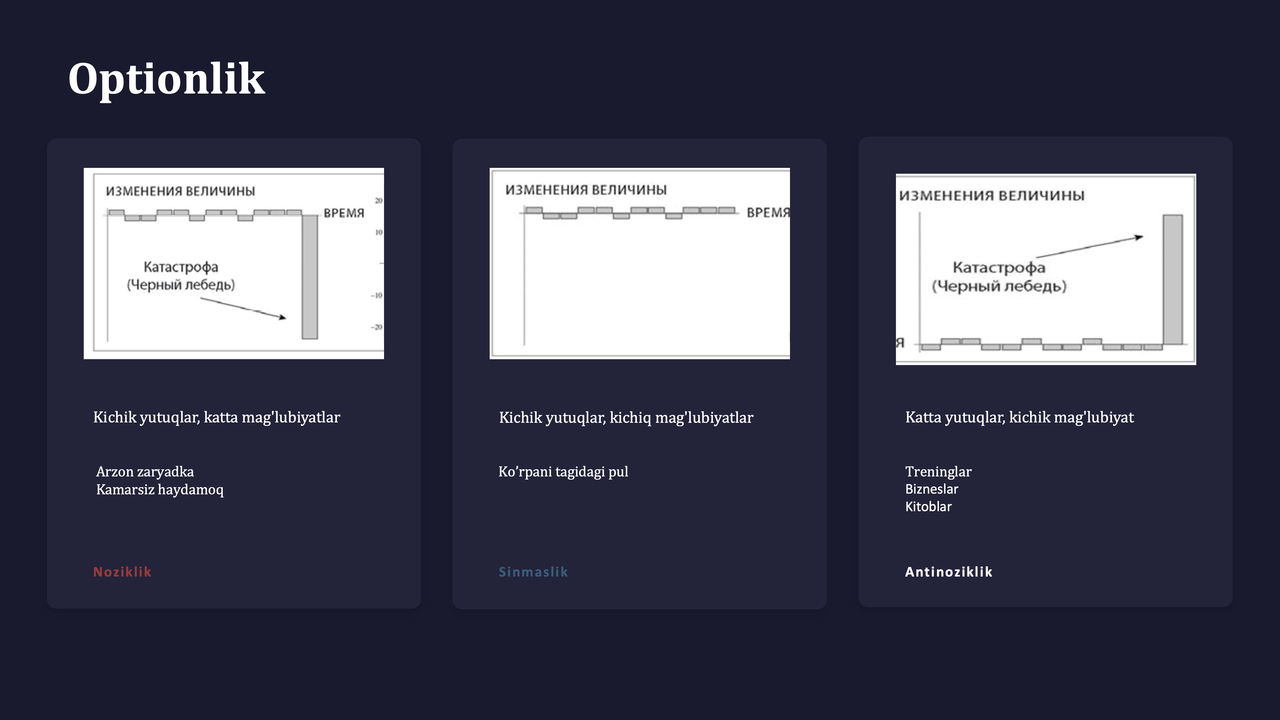
Optionality
We make decisions. We make choices. And our choice either wins or loses. Optionality means calculating what you’ll lose if your choice loses, and what you’ll gain if it wins. And if the loss is bigger than the gain, it’s better not to make that decision.
For example, you want to buy a phone charger. The original costs $50, a generic one $10. If you buy the generic one, you gain $40 (your gain). But if that charger fries your $1,000 phone, you lose $1,000 (your loss).