On How We Judge the World Around Us
I woke up on Sunday morning. It was cold outside, and raining too. Some acquaintance had called early. I decided to get up and take a walk. Gossiping women looked at me and said something. I wandered down to the riverbank. Fishermen were yelling at each other. The sun was hitting me in the eyes. The cold went right through me. “What on earth am I doing here?” I thought. As I slowly headed home, a dog latched onto me.
At that moment I woke up. It was my friend calling. When I woke, I thought: good thing that was a dream. I chatted with my friend for a bit. Outside the air was fresh after the rain, so I decided to go for a walk. I stepped out into a light drizzle. Right away I saw my neighbors. I went over and said hello. The ladies gave me their blessings. Walking on, I found myself at the riverbank. The air there was completely different. A little colder, but the sun, just out, seemed to warm everything. Some respected older men had come out to fish. They called out to me. I went over and greeted them. We talked for a while. They had seen a lot in life. As I slowly made my way home, a puppy ran up to me. It seemed to want to play. I played with it a little and bought it some food.
You can look at the same thing from different sides. We are the ones who judge a situation. We decide something is pleasant and something is unpleasant. Something is important, something isn’t.
How we judge the world around us is our subjective opinion. Your exams might be very important to you. Meanwhile your friend hasn’t even opened the book. Ask him and he’ll say, “Eh, we’ll pass somehow.” Whose position is more effective?
Today let’s talk about how we judge the world around us.
Our lives are made up of two kinds of events:
- Events we can’t influence. Other people’s opinions or actions, the weather, the season, the system of government, the exam answers, and so on. In other words, everything we have no power over.
- Events we can influence. Our values, our thoughts, our wishes and intentions. The things we do.
You can picture this as two circles:
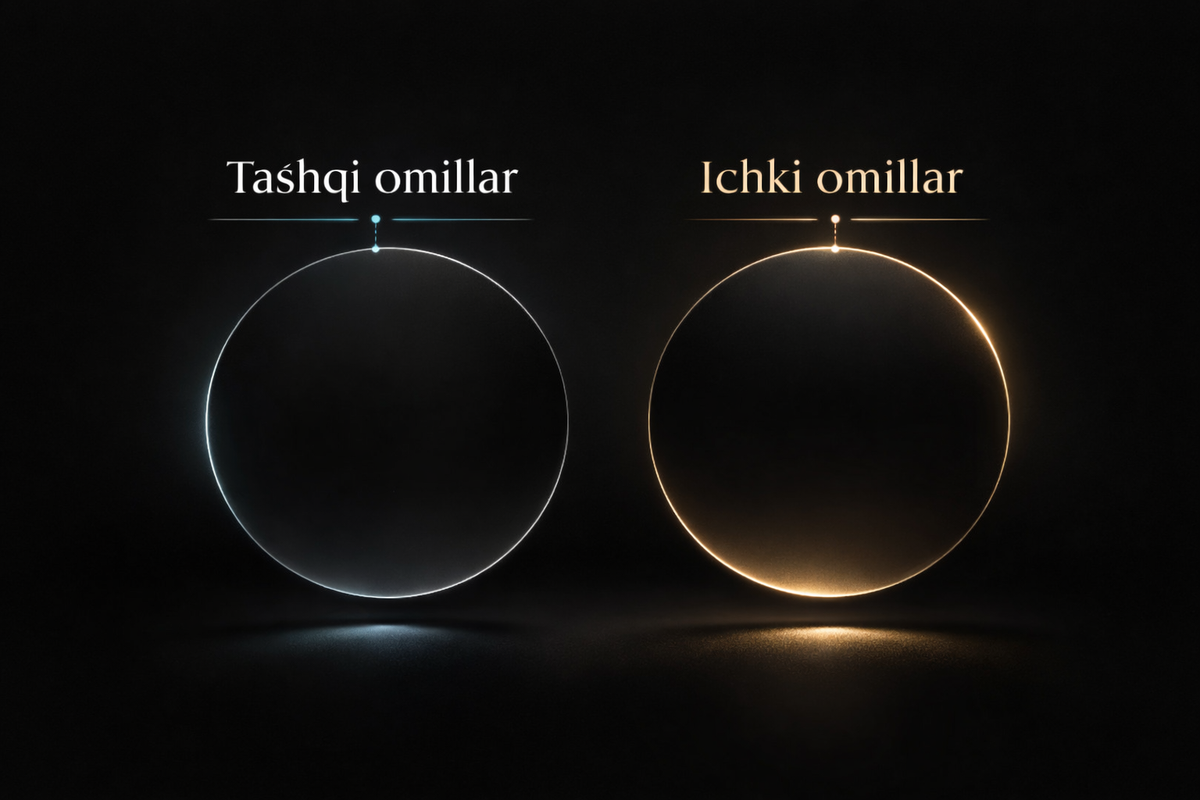
Our job is to remove external factors from our lives. More precisely, from our heads. We can’t influence external factors in any way. Why spend our resources on them?
That’s the core idea of Stoicism, too. Direct all our resources toward the things we can influence.
The price of gas went up. Can we influence that? I can’t. So it’s the left circle. We don’t think about it, don’t stress over it, don’t waste our time. Because time is a resource. Spending a resource on something you can’t influence — what is that if not foolish?
While I was writing this essay, I noticed a colleague was in a bad mood. I asked, and it turned out a client had left a bad review. The customer service department had made a mistake. Let’s analyze this. Break it into parts. Let’s decompose it. The client’s review is the left circle. We can’t make them delete what they wrote. It isn’t worth stressing over. Let’s not spend resources on it. But we can try to change their opinion of our company. We can try to solve their problem. And that’s the right circle. We do what we can. If it works, great. If it doesn’t, we did our best.
In any situation, we ask ourselves: which circle does this event belong to?
On importance
Imagine there’s a task in front of us. A problem, a project, a goal, a job, an exam — doesn’t matter. A task. What does it take to solve it? Solving any task takes resources. Resources come in many forms: money, time, energy, knowledge, connections, and so on. Some people have money but little time. Others have plenty of knowledge but less energy.
Wherever we put our resources, that’s where things grow. Spend money on renovating the house, and the house gets better. Invest in the car, and the car is worth more. Spend energy on learning English, and your English gets stronger. If our task is math, put in time and energy, and that gets solved too.
But there are also factors that hold a task back. Today let’s dig a little deeper into one of them. One of the things that keeps us from getting results is importance.
Yes, friends. Excessive importance turns out to be a negative factor. When we put resources into something, it grows. But when we give it importance, our results get worse.
Vadim Zeland writes in his book “The Space of Variations”:
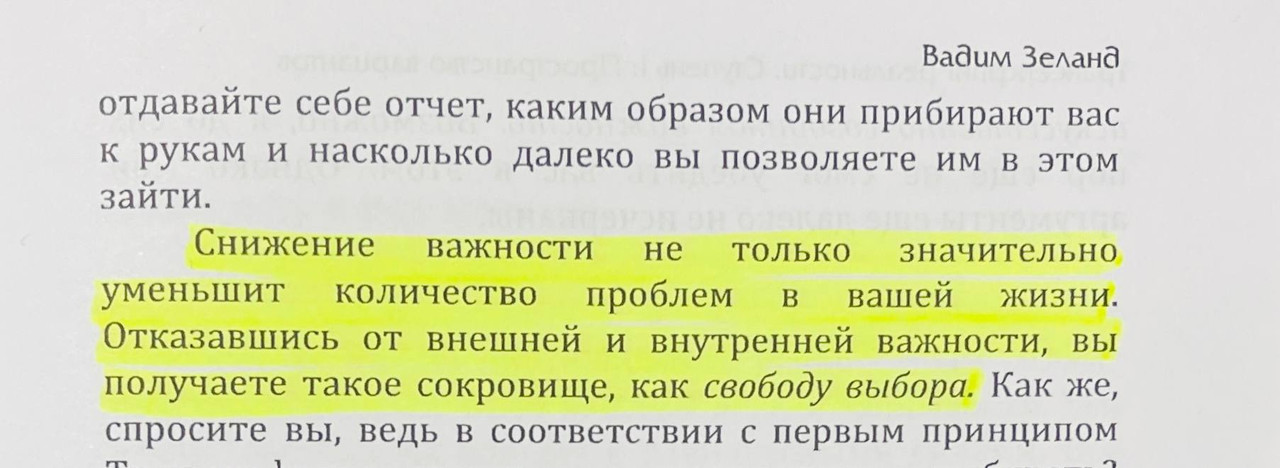
Lowering importance won’t just greatly reduce the number of problems in your life. By giving up importance in the eyes of others and in your own, you gain a priceless gift called freedom of choice.
There’s a task in front of you. You can give it huge importance. You can make the situation complicated. Or you can simplify it and get through it easily. Either way, the task will pass. But if you simplify it, you’ll make better decisions. Importance makes you anxious. Anxiety blocks clear thinking. Not being able to think clearly lowers the quality of how you manage your resources (Resource Management).
In other words, when we give a situation a lot of importance, we start getting bad results in it.
Up close, everything looks big. A plane in the sky is tiny. Walk up to it, and it looks enormous.
In the same way, up close a problem looks big. Look at it from above, and it doesn’t seem like much.
Say you scraped your car. Some people might panic. But what if you look at it from the height of a 70-year life? Imagine we’re 75, an old man or an old woman. Will we even remember slightly scratching a car when we were 25?
Margulan Seisembayev recently made a post about this too:
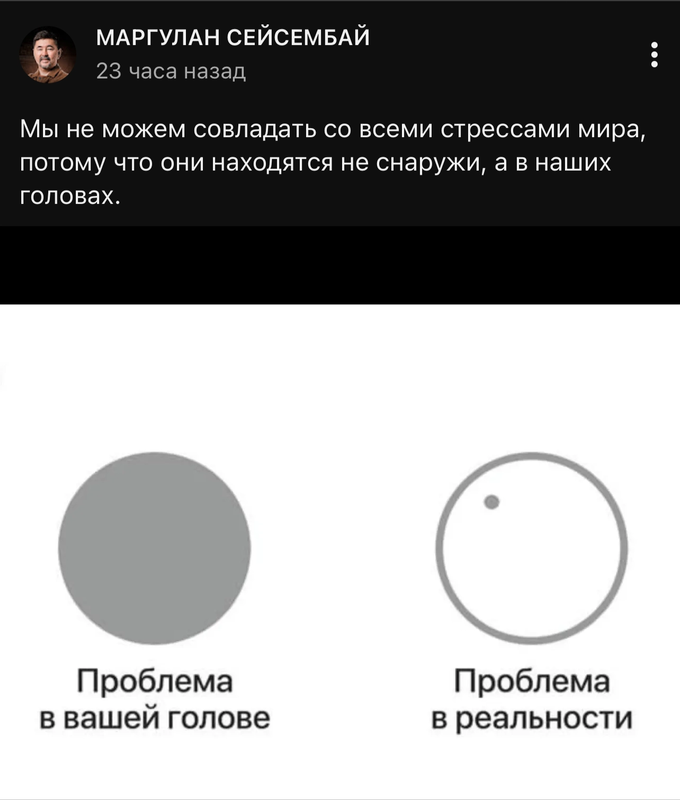
We can’t fight all the stress in the world, because it isn’t out there — it’s inside our heads. (← The problem in our eyes. The problem in real life →)
Conclusion
- When judging what’s around us, we always split events into two kinds. The left circle and the right circle.
- If it’s the left circle, we don’t spend our resources on it.
- The biggest enemy of our resources is importance. So we always let go of importance.
Who are the most effective people in life? The ones who put their resources in the right place.
They don’t fight the world.
They simplify the situation.
They do their part and don’t dwell on the outcome.
That’s why they say: “The world is run by the person least attached to the outcome.”